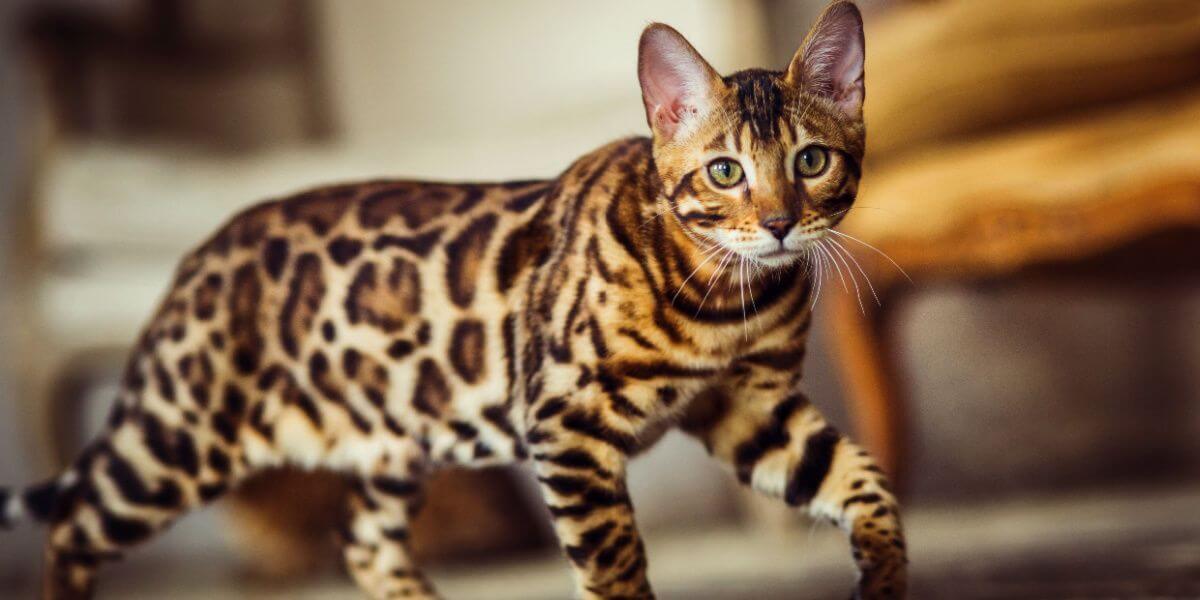
If you are considering adding a lively and intelligent companion to your home, look no further than the Bengal cat. The cat that looks like leopards but has a very lovely temperament — such a four-legged friend is a perfect match. Let’s take a deeper insight into the Bengal cat’s characteristics. Onwards!
Such house cats that look like leopards impress with their exotic look. This breed was created for people enjoying such unique appearances but modified for a comfortable city-style life — without the danger and the size of a real wild animal. It is a result of matching domestic cats with small Asian Leopard Cats, and it has been boosting its popularity since the 1960s.
That’s why these kitties are commonly pretty short-haired, energetic, large-boned, and multicolored — either a marbled or a spotted coat. What’s more, their fur is extremely silky and soft. It has a smooth and rabbit-like feel to it. The stunning coat of the Bengal varied widely in background colors, including orange, red, golden, ivory, and other notes. The same goes for the tone of this cat’s spots — chocolate brown and black aren’t rare.
These cats are typically far more chatty and active than average domestic pets because of their wild animal genes. They have extraordinary muscle systems and impress happy owners with their agility and athleticism. It is common to see them perched as high as possible in a room, including “topping” areas like refrigerators, cupboards, and door frames.
In the chart below, take a closer look at the breed’s core characteristics.
| Origin | United States |
| Lifespan | Up to fifteen years |
| Length | Up to eighteen inches |
| Weight | Ranging from twelve to twenty pounds |
| Eye color | Gold, green |
| Health issues | HCM, progressive retinal atrophy, etc. — medium complexity, on average |
| Energy level | High |
| Child-friendly | High |
| Dog-friendly | High |
| Stranger-friendly | Medium |
| Adaptability | High |
| Intelligence | High |
Given how active these pets are, it is great to offer something more than door frames for them to climb and jump on. Although they usually can swim, a lot depends on the individual cat’s preferences — other breeds can easily have a more water-friendly attitude.
Of course, standard care procedures for domestic cats will work for the Bengal as well. Clean their litter boxes and trim their nails every few weeks. Their diet also has to be healthy and well-balanced.
The same vaccines and prophylactic care means are required for your Bengal as they are for a typical domestic cat. Unlike their Asian Leopard Cat predecessor, these canines aren’t resistant to illnesses caused by the FeLV — feline leukemia virus. Unfortunately, such cats are more vulnerable to genetic diseases and disorders.
Overall, the number of illnesses and conditions your Bengal cat may suffer from includes but isn’t limited to the following:
All in all, these cats are the ideal candidate for a playful and active pet and playmate for children and other members of the family. While they require pretty much attention, they will also benefit from cat trees and similar playgrounds to promote their health and satisfy their natural needs.
You will have to be especially cautious about their eyes’ condition and monitor it regularly to avoid FIP and other diseases. Don’t forget about their wild nature — your aquarium inhabitants might be in danger. Otherwise, there is no reason to refuse to own such a lovely pet at home.